

For the last two decades, the pinnacle of professional boxing has been defined by a single, mathematical absolute: four. To be called the “undisputed” king or queen of a weight class, a fighter had to conquer a mountain guarded by four distinct sanctioning bodies – the WBC, WBA, IBF, and WBO.
It was a chaotic, often frustrating system, but it was the established law of the land.
That law is now under direct siege.With the aggressive rollout of Zuffa Boxing – the high-octane venture backed by TKO Group (the powerhouse behind the UFC) and Saudi Arabia’s Sela – the sport is staring down a structural civil war.
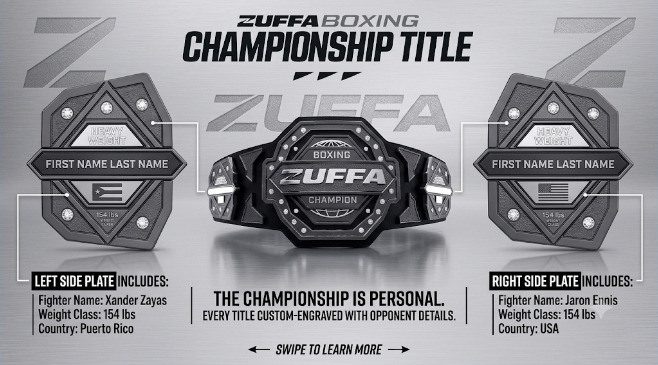
They aren’t just here to promote fights; they are introducing their own Zuffa Boxing World Title. Suddenly, the four-belt era is on life support, and five could soon become the new magic number for global supremacy.
The New Gold Standard?
We have already caught a glimpse of this new reality. When cruiserweight powerhouse Jai Opetaia captured the inaugural Zuffa Boxing cruiserweight title alongside The Ring belt, it wasn’t just a ceremonial gesture. It was a declaration of intent.
Zuffa Boxing is positioning its title not as a secondary gimmick, but as a premier championship that demands equal real estate on a fighter’s shoulders.
For fans and purists, this triggers an immediate headache. If a fighter holds the WBC, WBA, IBF, and WBO straps but doesn’t hold the Zuffa belt, can they truly be called undisputed?
The Corporate Cold War: Monopoly vs. Tradition
The boxing establishment has already drawn its battle lines. Traditional promoters, most notably Matchroom’s Eddie Hearn, have been vocal critics of the disruption. The argument from the old guard is simple: a corporate entity cannot simply manufacture decades of boxing lineage and prestige overnight. They see the fifth belt as an aggressive corporate play designed to implement a UFC-style monopoly, stripping away the independence that boxers have historically fought for.
But boxing has always been a sport governed by a different kind of green belt: money.
Zuffa Boxing isn’t just throwing a shiny new strap into the ring; they are backing it with an immense war chest, a massive exclusive streaming home on Paramount+, and significant political momentum. With the Muhammad Ali American Boxing Revival Act currently weaving its way through U.S. Congress, Zuffa is positioning itself to legally and structurally reshape how the sport is run.
Why the Belt Will Matter
At the end of the day, fighters risk their lives for two things: legacy and financial security. If Zuffa Boxing continues to offer career-high paydays and elite global distribution, the world’s best fighters will clamor to fight for their title.
When the dominant champions of the world start actively collecting the Zuffa strap alongside their traditional hardware, the debate will be over. The traditional sanctioning bodies will be forced to adapt, cooperate, or risk being left behind in the dust of a new empire.
The four-belt era gave boxing a rare sense of clarity after years of fragmentation. But history shows that combat sports never stay static for long. Whether the purists like it or not, the landscape is shifting under our feet—and the era of five belts is officially knocking on the door.